Choosing the right tractor horsepower is one of the most important decisions a Zimbabwean farmer can make. As a general rule, smallholder farms require 50–60 HP, medium-scale operations are best served by 60–75 HP, and large commercial farms typically need 75–85 HP. The right figure, however, depends on your farm size, soil type, terrain, and the implements you plan to use./
Getting this decision wrong is costly. Too little power and your tractor struggles under load, burns more fuel, and wears out faster. Too much and you are paying for capacity you never use. Here is how to get it right.
Why Horsepower Matters for Zimbabwean Farms
Tractor horsepower (HP) determines how much load a machine can pull, how efficiently it operates with mounted implements, and how well it performs on demanding terrain. Zimbabwe’s diverse agricultural landscape — from the sandy soils of Matabeleland to the heavier clays of Mashonaland — means there is no single answer for every farmer.
Horsepower Guide by Farm Type
Small to Medium Farms (Under 50 Hectares) — 50 HP
For smallholder farms or orchards, a 50 HP tractor offers compact dimensions, easy manoeuvrability, and low running costs. The Massey Ferguson MF-240 (50 HP) is a practical, economical choice. It handles light ploughing, tilling, and transport tasks with ease, and its simple 2.5D engine keeps maintenance costs low.
- Compatible implements: Chisel plough, bed maker, farm trailer, boom sprayer
- Best for: Maize, horticulture, mixed subsistence farming
Mixed-Use and Medium-Scale Operations — 60 HP
A 60 HP tractor strikes a strong balance for farms running multiple implement types across varied tasks. Both the MF-260 and MF-360 deliver turbocharged performance with high PTO output, making them well suited to rotavators, threshers, and cotton ridgers.
- Compatible implements: Cotton ridger, rotary tiller, offset disc harrows
- Best for: Tobacco, cotton, and mixed commercial cropping
Larger Commercial Farms on Flat Terrain — 75 HP
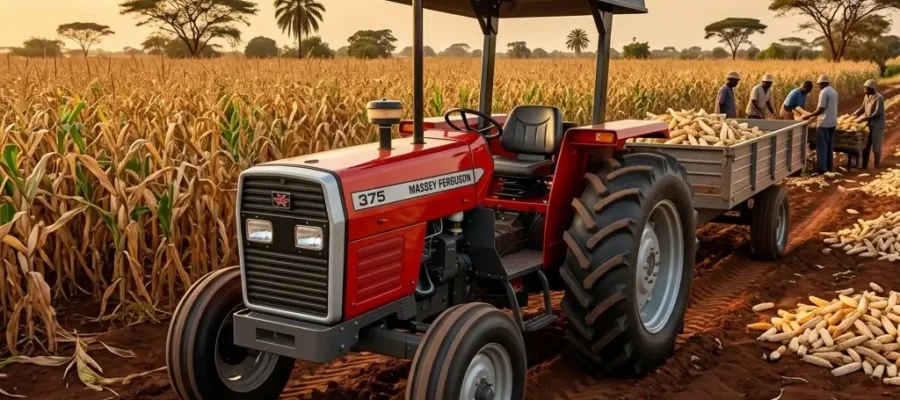
The MF-375 2WD (75 HP) delivers strong drawbar pull with excellent fuel economy, making it a reliable workhorse for high-volume field operations. Its hydrostatic power steering and heavy-duty front axle support long working days without driver fatigue.
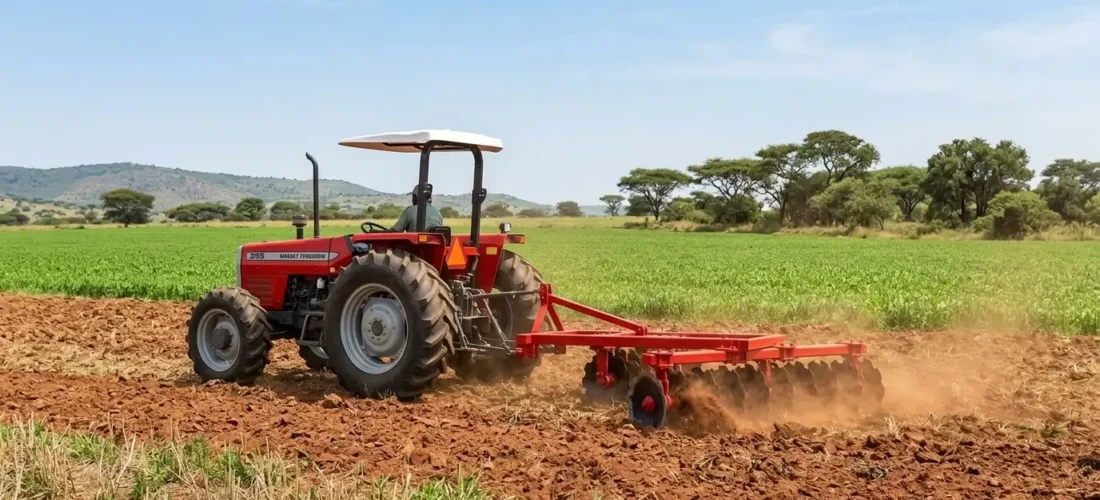
- Compatible implements: Disc plough, agricultural loader, farm trailer
- Best for: Large-scale maize, wheat, and soya bean production
Heavy-Duty Operations and Hilly Terrain — 85 HP
For the most demanding conditions — including heavy clay soils, hillside farming, or high-output commercial operations — the MF-385 4WD (85 HP) is the recommended choice. Compared to its 2WD equivalent, it delivers 30% more traction, 34% more drawbar pull, and 15% greater fuel efficiency — essential for maximising productivity across Zimbabwe’s toughest terrain.
- Compatible implements: Disc plough (requires 85 HP+), agricultural loader, hydraulic tipping trailer
- Best for: Large-scale tobacco, commercial tillage, hilly or clay-heavy land
Quick HP Reference Table
| Farm Type | Recommended HP | Recommended Model |
|---|---|---|
| Smallholder / orchard | 50 HP | MF-240 |
| Mixed-use / medium scale | 60 HP | MF-260 or MF-360 |
| Large-scale / flat terrain | 75 HP | MF-375 2WD or 4WD |
| Heavy-duty / hilly terrain | 85 HP | MF-385 2WD or 4WD |
Frequently Asked Questions
Can a 50 HP tractor handle disc ploughing in Zimbabwe?
A standard disc plough typically requires 85 HP or more. A 50 HP tractor like the MF-240 is better suited to lighter soil preparation tasks such as chisel ploughing, tilling, and bed making. Using an undersized tractor with a disc plough will strain the engine and reduce the lifespan of both the tractor and the implement.
Is a 4WD tractor worth the extra cost for Zimbabwean farms?
For farms with hilly terrain, heavy soils, or high-demand fieldwork, a 4WD tractor delivers significantly better traction and reduced tyre wear — making it the more cost-effective choice over the long term. The MF-385 4WD, for example, offers 30% more traction and 15% better fuel efficiency than its 2WD counterpart.
Which Massey Ferguson tractor is best for maize farming in Zimbabwe?
The MF-375 (75 HP) is a popular choice for maize farming, offering a strong balance of pulling power and fuel economy. For larger operations or heavier soils, the MF-385 4WD (85 HP) provides additional capacity for deep tillage and high-output planting seasons.

Related Posts